Estimation of Stature from Hand Length and Foot Length among Young Adults: A Cross-Sectional Anthropometric Study.
- Purushottam Madhukar Khade , M.D. (Forensic Medicine), Medical Officer, JJ Postmortem Centre, Mumbai.
- Shailendra Hemant Anande , M.D. (Forensic Medicine), Medical Officer, JJ Postmortem Centre, Mumbai,
- Piyush Subhash Gavale , M.D. (Forensic Medicine), Assistant Professor, Department of Forensic Medicine and Toxicology, JMF’s ACPM Medical College, Dhule.
- G. S. Chavan , M.D. (Forensic Medicine), Professor, Department of Forensic Medicine and Toxicology, Grant Government Medical College, Mumbai.
- B. G. Chikhalkar , M.D. (Forensic Medicine), Professor & Head, Department of Forensic Medicine and Toxicology, Grant Government Medical College, Mumbai.
Article Information:
Abstract:
Background: Stature estimation is an important component of personal identification in forensic investigations, particularly when complete human remains are unavailable. Hand length and foot length are useful anthropometric parameters that can aid in stature estimation due to their significant correlation with body height. Materials and Methods: A cross-sectional observational study was conducted among 200 medicolegal antemortem cases comprising 100 males and 100 females aged 16–30 years. Stature, hand length, and foot length were measured using standard anthropometric techniques. Pearson’s correlation coefficient was used to assess the relationship between stature and anthropometric measurements, and linear regression analysis was performed to derive sex-specific regression equations. Results: The mean stature, hand length, and foot length were significantly higher among males than females (p < 0.001). Significant positive correlations were observed between stature and hand length as well as foot length in both sexes. Among males, foot length showed a stronger correlation with stature (r = 0.622) than hand length (r = 0.575). Among females, hand length demonstrated the strongest correlation with stature (r = 0.657), followed by foot length (r = 0.624). Regression analysis yielded the equations: Stature = 99.88 + 3.747 × Hand Length and Stature = 99.16 + 2.951 × Foot Length for males, and Stature = 75.51 + 4.691 × Hand Length and Stature = 76.96 + 3.642 × Foot Length for females. The lowest standard error of estimate was observed for foot length in males (±4.3 cm) and hand length in females (±5.4 cm). Conclusion: Hand length and foot length showed significant positive correlations with stature and can be used as reliable predictors of stature. Foot length was the better predictor among males, whereas hand length demonstrated superior predictive ability among females. The derived sex-specific regression equations may be useful in forensic identification and medicolegal investigations.
Keywords:
Article :
INTRODUCTION:
Stature is one of the most important biological parameters used for personal identification in forensic investigations. Estimation of stature assumes considerable significance when only mutilated, fragmented, or incomplete human remains are available, such as in cases of mass disasters, transportation accidents, explosions, and criminal dismemberment. Accurate determination of stature contributes substantially to the establishment of an individual's biological profile and aids in narrowing the pool of potential identities during medico-legal investigations [1,2].
Anthropometry, the scientific study of human body measurements, has long been utilized in forensic medicine and physical anthropology for estimating various characteristics of an individual, including age, sex, race, and stature. Since the dimensions of different body parts exhibit proportional relationships with overall body height, measurements of specific anatomical structures can be used to predict stature with reasonable accuracy [3,4]. Traditionally, stature estimation has relied on long bone measurements; however, recovery of complete long bones is not always possible in forensic situations. Consequently, researchers have explored alternative body parameters such as hand length, foot length, head dimensions, and footprints for stature estimation [5,6].
Among these parameters, hand and foot dimensions have attracted particular attention because of their strong biological correlation with stature. The human hand and foot are frequently recovered intact in cases involving mutilated remains, explosions, and mass disasters, making them valuable structures for forensic identification. Furthermore, measurement of hand and foot length is simple, rapid, non-invasive, and less susceptible to measurement errors compared to long bone assessments [5,7]. Previous studies have demonstrated significant positive correlations between stature and hand length as well as foot length in different populations [8-10].
Several investigators have developed population-specific regression equations for stature estimation using hand and foot measurements. Vijaykumar et al. reported a significant relationship between foot length and stature among individuals from Karnataka and established regression equations for stature prediction [8]. Dave et al. observed a strong correlation between foot length and stature in the Gujarat population and emphasized the importance of population-specific standards [9]. Similarly, Khan et al. demonstrated significant associations between hand length and stature among medical students in Uttar Pradesh [10]. Studies conducted in Sri Lankan, Turkish, Korean, Egyptian, and North Indian populations have also reported statistically significant correlations between hand length, foot length, and stature, although the strength of association and regression coefficients varied among populations due to ethnic, genetic, nutritional, and environmental differences [11-15].
It is well recognized that no universal formula exists for stature estimation because body proportions differ across populations and between sexes [16]. Therefore, regression equations developed for one ethnic group may not be directly applicable to another. India is characterized by considerable ethnic and geographical diversity, necessitating region-specific anthropometric studies for accurate forensic application. Despite the availability of several studies from different regions of India, data regarding stature estimation from hand and foot length among medicolegal subjects in Maharashtra remain limited.
The present study was therefore undertaken to evaluate the relationship between stature, hand length, and foot length among medicolegal antemortem cases referred to a tertiary care centre and to derive sex-specific regression equations for the estimation of stature from hand and foot measurements. Such population-specific standards may provide valuable assistance in forensic identification and medico-legal investigations.
MATERIALS AND METHODS:
A cross-sectional observational study was conducted among 200 medicolegal antemortem cases referred to a tertiary care centre. The study population comprised 100 males and 100 females aged 16–30 years who fulfilled the inclusion criteria and provided informed consent for participation. Subjects with congenital skeletal deformities, endocrine disorders, known nutritional deficiencies, or a history of fractures involving the growing ends of hand and foot bones were excluded from the study. Ethical approval was obtained from the Institutional Ethics Committee before commencement of the study. All anthropometric measurements were recorded by a single observer between 2:00 PM and 5:30 PM to minimize inter-observer and diurnal variations.
Stature, hand length, and foot length were measured using standard anthropometric techniques. Stature was measured in centimetres using a stadiometer with the subject standing barefoot in the Frankfurt plane. Hand length was measured as the distance from the midpoint of the distal wrist crease to the tip of the middle finger, while foot length was measured from the most posterior point of the heel to the tip of the longest toe using a sliding caliper. All measurements were recorded three times and the average value was considered for analysis. Descriptive statistics were used to summarize the data. Pearson’s correlation coefficient was employed to assess the relationship between stature and hand length and foot length. Simple linear regression analysis was performed separately for males and females to derive sex-specific regression equations for stature estimation. Statistical significance was considered at a p-value of <0.05.
RESULTS:
Table 1. Baseline Characteristics and Anthropometric Measurements of Study Participants
|
Parameter |
Male (n=100) |
Female (n=100) |
|
Age (years) |
23.18 ± 2.40 |
22.60 ± 2.05 |
|
Stature (cm) |
172.89 ± 7.30 |
160.90 ± 7.80 |
|
Hand Length (cm) |
19.40 ± 1.10 |
18.20 ± 1.10 |
|
Foot Length (cm) |
24.90 ± 1.60 |
23.10 ± 1.30 |
A total of 200 participants were included in the study, comprising 100 males and 100 females. The mean age of male participants was 23.18 ± 2.40 years, while that of female participants was 22.60 ± 2.05 years. Male participants demonstrated higher anthropometric measurements than females across all parameters assessed. The mean stature among males was 172.89 ± 7.30 cm, compared to 160.90 ± 7.80 cm among females. Similarly, the mean hand length was greater in males (19.40 ± 1.10 cm) than in females (18.20 ± 1.10 cm). The mean foot length was also higher among males (24.90 ± 1.60 cm) compared to females (23.10 ± 1.30 cm). These findings indicate the presence of sexual dimorphism in stature as well as hand and foot dimensions within the study population, with males exhibiting consistently larger measurements than females (Table 1).
Table 2. Comparison of Anthropometric Measurements Between Male and Female Participants
|
Parameter |
Male Mean ± SD |
Female Mean ± SD |
t-value |
p-value |
|
Stature (cm) |
172.89 ± 7.30 |
160.90 ± 7.80 |
11.23 |
<0.001 |
|
Hand Length (cm) |
19.40 ± 1.10 |
18.20 ± 1.10 |
7.71 |
<0.001 |
|
Foot Length (cm) |
24.90 ± 1.60 |
23.10 ± 1.30 |
8.73 |
<0.001 |
The comparison of anthropometric measurements between male and female participants revealed statistically significant differences for all parameters studied. Male participants had a significantly greater mean stature (172.89 ± 7.30 cm) than female participants (160.90 ± 7.80 cm) (t = 11.23, p < 0.001). Similarly, the mean hand length was significantly higher among males (19.40 ± 1.10 cm) compared to females (18.20 ± 1.10 cm) (t = 7.71, p < 0.001). Foot length also showed a significant sex-based difference, with males exhibiting a greater mean foot length (24.90 ± 1.60 cm) than females (23.10 ± 1.30 cm) (t = 8.73, p < 0.001). These findings demonstrate significant sexual dimorphism in stature, hand length, and foot length, indicating that males possess larger anthropometric dimensions than females in the study population (Table 2).
Table 3. Correlation Between Stature and Hand Length and Foot Length
|
Variable |
Pearson Correlation (r) |
p-value |
|
Male Hand Length vs Stature |
0.575 |
<0.001 |
|
Male Foot Length vs Stature |
0.622 |
<0.001 |
|
Female Hand Length vs Stature |
0.657 |
<0.001 |
|
Female Foot Length vs Stature |
0.624 |
<0.001 |
Pearson’s correlation analysis demonstrated a statistically significant positive relationship between stature and both hand length and foot length in male and female participants (Table 3). Among males, stature showed a moderate positive correlation with hand length (r = 0.575, p < 0.001) and foot length (r = 0.622, p < 0.001), indicating that foot length exhibited a slightly stronger association with stature than hand length. Similarly, among females, significant positive correlations were observed between stature and hand length (r = 0.657, p < 0.001) as well as foot length (r = 0.624, p < 0.001). The strongest correlation in the study was observed between stature and hand length in females (r = 0.657), whereas the weakest, though still statistically significant, correlation was found between stature and hand length in males (r = 0.575). These findings suggest that both hand length and foot length are reliable anthropometric parameters for stature estimation, with the strength of correlation varying slightly according to sex.
Table 4. Sex-Specific Regression Equations for Estimation of Stature
|
Gender |
Predictor Variable |
Regression Equation |
SEE |
|
Male |
Hand Length |
Stature = 99.88 + 3.747 × Hand Length |
±4.8 |
|
Male |
Foot Length |
Stature = 99.16 + 2.951 × Foot Length |
±4.3 |
|
Female |
Hand Length |
Stature = 75.51 + 4.691 × Hand Length |
±5.4 |
|
Female |
Foot Length |
Stature = 76.96 + 3.642 × Foot Length |
±6.7 |
Sex-specific linear regression equations were derived to estimate stature from hand length and foot length in male and female participants (Table 4). Among males, stature could be estimated from hand length using the equation Stature = 99.88 + 3.747 × Hand Length, with a standard error of estimate (SEE) of ±4.8 cm. Similarly, foot length predicted stature using the equation Stature = 99.16 + 2.951 × Foot Length, with a lower SEE of ±4.3 cm, indicating slightly greater predictive accuracy compared to hand length.
Among females, the regression equation based on hand length was Stature = 75.51 + 4.691 × Hand Length, with an SEE of ±5.4 cm. Foot length predicted stature using the equation Stature = 76.96 + 3.642 × Foot Length, with an SEE of ±6.7 cm. Comparison of the standard errors of estimate revealed that foot length provided the most accurate prediction of stature among males, whereas hand length showed relatively better predictive accuracy among females. These regression models may serve as useful tools for stature estimation in medicolegal and forensic identification when only hand or foot measurements are available.
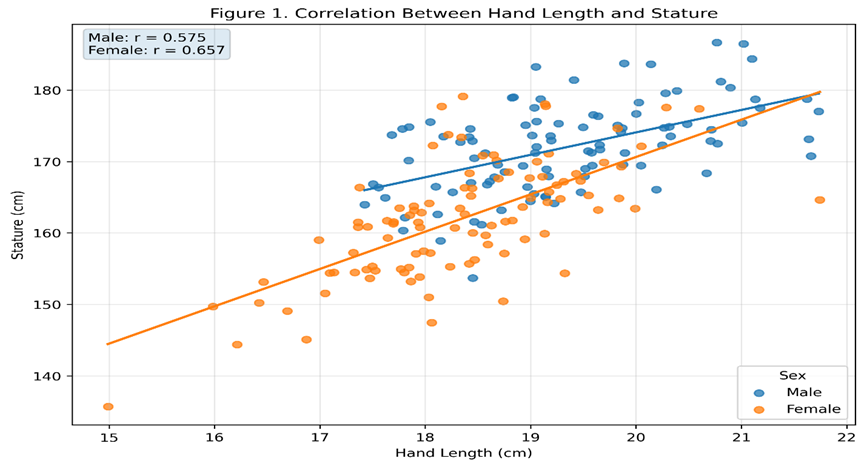
Figure 1 illustrates the relationship between hand length and stature among male and female participants. The scatter plot demonstrates a positive linear association between hand length and stature in both sexes, indicating that individuals with greater hand length tend to have greater stature. The data points are distributed around the regression lines, showing a moderate degree of correlation between the two variables. Among male participants, a statistically significant moderate positive correlation was observed between hand length and stature (r = 0.575, p < 0.001). Similarly, female participants exhibited a statistically significant moderate positive correlation (r = 0.657, p < 0.001). The correlation was stronger among females than males, suggesting that hand length may be a slightly better predictor of stature in females within the study population. The upward slope of the regression lines in both groups further confirms that stature increases with increasing hand length. These findings support the utility of hand length as a reliable anthropometric parameter for stature estimation in forensic and medicolegal investigations.
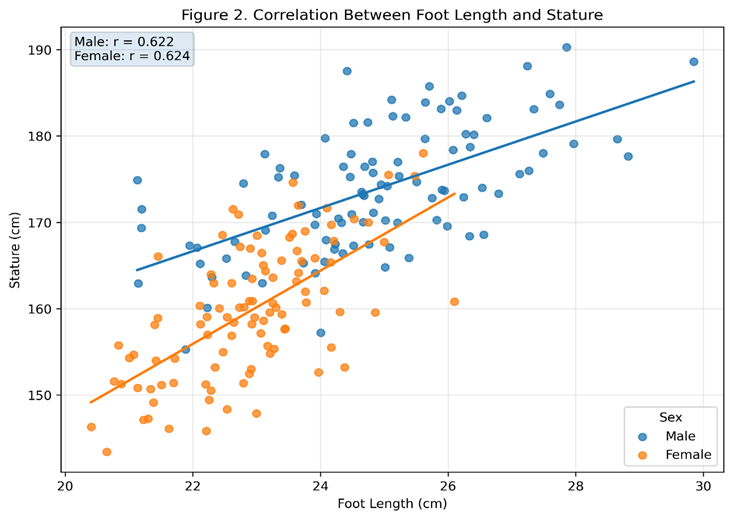
Figure 2 depicts the relationship between foot length and stature among male and female participants. The scatter plot demonstrates a clear positive linear association between foot length and stature in both sexes, indicating that individuals with longer feet generally tend to have greater stature. The clustering of observations around the regression lines suggests a moderate degree of correlation between the variables.
Among male participants, foot length showed a statistically significant moderate positive correlation with stature (r = 0.622, p < 0.001). Among female participants, a similarly significant positive correlation was observed (r = 0.624, p < 0.001). The strength of correlation was nearly identical in males and females, indicating that foot length is a reliable predictor of stature irrespective of sex. Furthermore, the correlation coefficient for foot length was higher than that observed for hand length among males, suggesting that foot length provides a more accurate estimate of stature in male individuals. The positive slope of the regression lines confirms that stature increases proportionately with increasing foot length. These findings support the use of foot length as an important anthropometric parameter for stature estimation in forensic identification and medicolegal investigations, particularly when complete body measurements are unavailable.
DISCUSSION:
The present study was undertaken to evaluate the relationship between stature, hand length, and foot length among medicolegal antemortem cases and to derive sex-specific regression equations for stature estimation. Stature estimation is an important component of personal identification in forensic investigations, particularly in situations involving mutilated, fragmented, or incomplete human remains. Anthropometric parameters such as hand length and foot length are frequently utilized for this purpose because of their accessibility, ease of measurement, and demonstrated correlation with stature [1-6].
In the present study, males exhibited significantly greater stature, hand length, and foot length than females. The mean stature was 172.89 ± 7.30 cm among males and 160.90 ± 7.80 cm among females. Similarly, mean hand length and foot length were significantly greater in males than in females (p < 0.001). These findings are consistent with the well-established phenomenon of sexual dimorphism in anthropometric characteristics. Similar observations have been reported by Vijaykumar et al. [8], Dave et al. [9], Khan et al. [10], and Ilayperuma et al. [11], who demonstrated significantly larger hand and foot dimensions among males compared to females. The observed sex differences may be attributed to genetic, hormonal, and environmental factors influencing skeletal growth and body proportions.
Correlation analysis in the present study demonstrated statistically significant positive associations between stature and both hand length and foot length in males and females. Among males, hand length showed a moderate positive correlation with stature (r = 0.575), while foot length demonstrated a slightly stronger correlation (r = 0.622). These findings suggest that foot length is a better predictor of stature than hand length among male participants. Similar results have been reported by Vijaykumar et al. [8], who observed a stronger relationship between foot length and stature compared to other body dimensions. Dave et al. [9] also reported significant positive correlations between foot length and stature, emphasizing the usefulness of foot measurements in forensic identification.
Among female participants, hand length exhibited the strongest correlation with stature (r = 0.657), followed closely by foot length (r = 0.624). These findings indicate that both hand length and foot length can be reliably used for stature estimation in females, although hand length may provide slightly greater predictive accuracy. Comparable observations were reported by Khan et al. [10], who found significant correlations between hand dimensions and stature among young adults. Ilayperuma et al. [11] similarly reported that hand length was a reliable predictor of stature in the Sri Lankan population. The variation in correlation coefficients observed across different studies may be attributed to ethnic, genetic, nutritional, and geographical differences among study populations.
The strength of correlation observed in the present study was moderate rather than strong, indicating that although hand length and foot length are useful predictors of stature, other biological and environmental factors also influence body height. Similar moderate correlations have been reported in studies conducted in Indian and international populations [12-15]. The findings reinforce the concept that stature estimation models should be population-specific because anthropometric relationships vary considerably across ethnic groups. Consequently, regression equations derived in one population may not be directly applicable to another population.
Regression analysis was performed to derive sex-specific equations for stature estimation. Among males, the equation based on foot length (Stature = 99.16 + 2.951 × Foot Length) yielded a lower standard error of estimate (SEE ±4.3 cm) than the equation based on hand length (SEE ±4.8 cm), indicating superior predictive accuracy. In contrast, among females, the equation based on hand length (SEE ±5.4 cm) performed better than the equation based on foot length (SEE ±6.7 cm). These findings are consistent with the correlation analysis and suggest that foot length may be the preferred parameter for stature estimation in males, whereas hand length may be slightly more reliable in females.
Several investigators have developed regression equations for stature estimation using hand and foot dimensions. However, considerable variation exists in the regression coefficients reported by different studies due to differences in ethnicity, age distribution, nutritional status, and environmental influences [8-15]. The present study contributes population-specific regression equations for individuals from Maharashtra, thereby enhancing the available anthropometric database for forensic applications in this region. Such regional standards are particularly important because India exhibits substantial biological diversity across different geographic areas.
The practical implications of the present findings are significant in forensic medicine and anthropology. In situations involving mass disasters, explosions, train accidents, aircraft crashes, or dismembered remains, complete skeletal measurements may not be available. Under such circumstances, hand and foot dimensions can provide valuable information for estimating stature and narrowing the identity of unknown individuals. The derived regression equations may therefore serve as useful adjuncts in forensic identification when only partial remains are recovered.
The present study has certain limitations. The study was conducted at a single tertiary care centre and included participants within a limited age range of 16–30 years. Therefore, the findings may not be generalizable to other age groups or populations. Furthermore, the regression equations were developed using living subjects and may require validation in larger multicentric studies before widespread forensic application.
Despite these limitations, the study demonstrates significant positive correlations between stature and hand and foot dimensions and provides reliable sex-specific regression equations for stature estimation. The findings support the use of hand length and foot length as practical anthropometric parameters for personal identification in forensic and medicolegal investigations.
CONCLUSION:
The present study demonstrated significant positive correlations between stature and both hand length and foot length in males and females (p < 0.001). Among males, foot length showed a stronger correlation with stature (r = 0.622) than hand length (r = 0.575), while among females, hand length showed the strongest correlation (r = 0.657) followed by foot length (r = 0.624). The regression equation based on foot length provided the most accurate prediction of stature in males (SEE ±4.3 cm), whereas hand length was a better predictor in females (SEE ±5.4 cm). These findings indicate that hand length and foot length are reliable anthropometric parameters for stature estimation and can be effectively utilized in forensic identification and medicolegal investigations when complete body measurements are unavailable.
REFERENCES:
1. Krishan K, Sharma A. Estimation of stature from dimensions of hands and feet in a North Indian population. J Forensic Leg Med. 2007;14(6):327-32.
2. Jain U, Ma M. Height shrinkage, health and mortality among older adults: evidence from Indonesia. Econ Hum Biol. 2020;37:100863.
3. Schultz EA, Lavenda RH. Anthropology: A perspective on the human condition. New York: McGraw-Hill; 1998.
4. Sunil, Dikshit PC, Aggrawal A, Rani MSS. Estimation of stature from hand length. J Indian Acad Forensic Med. 2005;27:219-21.
5. Chikhalkar BG, Howal P, Bhinde KJ, Deshmukh SS, Nanandkar DS. Estimation of stature from measurements of hand dimensions. JHRMLP. 2017;3(2).
6. Panchal-Kildare S, Malone K. Skeletal anatomy of the hand. Hand Clin. 2013;29(4):459-71.
7. Malik AR, Akhter N, Ali R, Farrukh R, Aziz K. A study on estimation of stature from foot length. Prof Med J. 2015;22(5):632-9.
8. Vasudeva Murthy. Estimation of height of person from foot length in Davangere. Int J Plant Anim Environ Sci. 2013;3.
9. Patel JP, Shah RK, Kanani SD, Dave RV. Estimation of height from measurement of foot length in Gujarat region. Int J Biol Med Res. 2012;3(3):2121-5.
10. Khan AZ, Jahan N, Haque M. Estimation of stature based on hand length among students of Uttar Pradesh. Indian J Clin Anat Physiol. 2020;7(3):271-6.
11. Ilayperuma I, Nanayakkara G, Palahepitiya N. Prediction of personal stature based on the hand length. Galle Med J. 2009;14:15-8.
12. Sanli SG, Kizilkanat ED, Boyan N, Ozsahin ET, Bozkir MG, Soames R, et al. Stature estimation based on hand length and foot length. Clin Anat. 2005;18:589-96.
13. Kim W, Kim YM, Yun MH. Estimation of stature from hand and foot dimensions in Korean population. J Forensic Leg Med. 2018;55:87-92.
14. Mohamed MH. Measurement of foot and hand dimensions and their correlation with height in adult Upper Egyptians. Al-Azhar Assiut Med J. 2013;10(4).
15. Krishan K. Anthropometry in forensic medicine and forensic science—Forensic anthropometry. Internet J Forensic Sci. 2007;2(1).